How the Middle East Conflict Is Reshaping Migration, Business and Supply-Chain Resilience

How the Middle East Conflict Is Reshaping Migration, Business and Supply-Chain Resilience
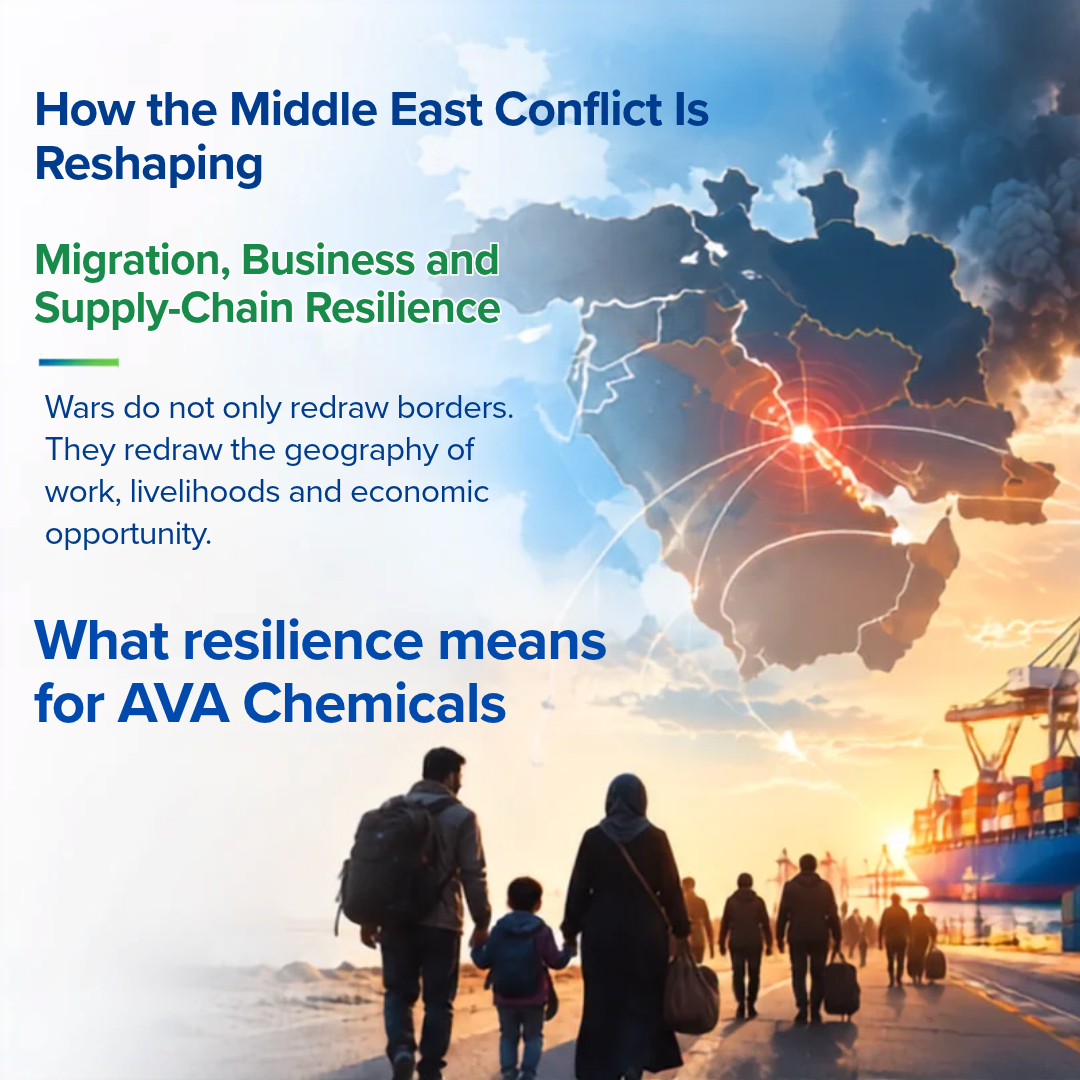
Wars do not only redraw borders. They redraw the geography of work, livelihoods and economic opportunity. The repeated escalation of the Iran-US-Israel conflict since February 2026 has demonstrated this once again. What began as a direct confrontation has generated wider instability across the region, affecting Lebanon, Syria, Iraq, Yemen and the Gulf. The consequences are being felt not only through insecurity, but through decisions about where people can safely live and work—and, increasingly, how businesses can continue to operate in an uncertain environment. The scale of displacement is significant. UNHCR estimates that between 600,000 and one million Iranian households—up to 3.2 million people—were temporarily displaced within Iran during the early phase of the conflict. Cross-border movements have also increased, although much of this movement remains temporary and reversible. This distinction matters. Conflict does not automatically create permanent migration. People may move internally or cross temporarily into a neighbouring country. They may return when conditions improve, or, if instability persists, eventually seek longer-term relocation. In Lebanon, for example, the International Organization for Migration recorded more than 430,000 internally displaced people in July, alongside more than 730,000 who had begun returning to their communities.

The economic dimension of migration:

For India, however, the migration story has another dimension.

The Gulf is one of the world's most important labour corridors for Indians, with more than nine million Indian workers across the region. A prolonged disruption to Gulf economies has implications far beyond the immediate safety of those directly affected. It can influence employment, household incomes and the remittances that connect overseas workers to India's domestic economy. India received approximately $143 billion in remittances in FY2025–26. Migration, therefore, is not simply a demographic phenomenon. It is an important component of India's economic resilience.

The paradox is that migrant workers are simultaneously among the most vulnerable to geopolitical shocks and among the most important contributors to economic stability.

When businesses slow hiring, projects are postponed or mobility is restricted, the effects can travel from workplaces in the Gulf to households thousands of kilometres away in India.

But there is another, less visible transmission mechanism: supply chains.

When people move, supply chains move too:

Modern supply chains depend not only on raw materials, factories and logistics networks, but also on people—the engineers operating plants, technicians maintaining equipment, drivers moving goods, procurement teams managing supplies and skilled professionals supporting customers.

When geopolitical instability disrupts the movement or availability of people, businesses can face consequences well beyond their immediate geography.

Projects may be delayed. Plants may operate below capacity. Maintenance schedules can be affected. Customers may seek alternative suppliers. Logistics routes can become unpredictable. And companies may need to carry additional inventory or qualify alternate sources simply to protect continuity.

This is particularly relevant for industries such as chemicals, pharmaceuticals, agrochemicals, water treatment, oil & gas and home and personal care, where the availability of a critical raw material or intermediate can affect an entire production chain.

The lesson is increasingly clear: supply-chain resilience is ultimately human resilience.

From alternate suppliers to dependable partnerships:

For businesses, resilience therefore cannot be measured only by inventories, alternate suppliers or logistics routes. It must also account for people—their skills, experience and the communities on which supply chains ultimately depend.

It also changes the way companies should think about their suppliers. In a volatile geopolitical environment, the value of a supplier is not determined only by price or capacity. Reliability, technical capability, manufacturing flexibility, responsiveness and the ability to maintain supply during periods of disruption become equally important.

For chemical manufacturers, this means investing in manufacturing capacity, technical expertise, quality systems and customer relationships that can withstand unexpected shocks.

It means having the ability to support customers when their requirements change, when supply routes are disrupted, or when they need to qualify an alternate source quickly.

What resilience means for AVA Chemicals:

This is the philosophy that has shaped AVA Chemicals for more than four decades.

As a manufacturer serving the agrochemical, pharmaceutical, home & personal care, oil & gas and water treatment industries, we operate within supply chains where reliability of a critical chemical ingredient can have consequences far beyond the product itself.

Our focus, therefore, is not simply on manufacturing and supplying chemicals. It is on building the capacity, technical expertise and partnerships that help our customers maintain continuity in an unpredictable world.

With growing manufacturing capacity across our plants and strong contract manufacturing capabilities, AVA is investing in the flexibility required to support customers as their markets, requirements and supply-chain strategies evolve.

We believe that long-term resilience is built through dependable partnerships—not just through transactions.

The Middle East conflict is a reminder that the movement of people and the movement of economies are inseparable. As geopolitical shocks become more frequent, countries and businesses will need to think beyond physical supply chains and build human and industrial resilience into their planning.

Wars may determine where people can move today. For businesses, the greater challenge is ensuring that wherever people, products and supply chains move tomorrow, productive relationships and reliable supply can continue.

At AVA Chemicals, we believe that is what a long-term partnership should deliver.

Ready to Partner With Us?

Join global leaders who trust AVA Chemicals for their chemical supply needs. Our team will get back to you within 24 hours.

WhatsApp