This phenomenon decreases the availability of both the phosphate and zinc nutrients to the crops and also leads to soil quality deterioration.
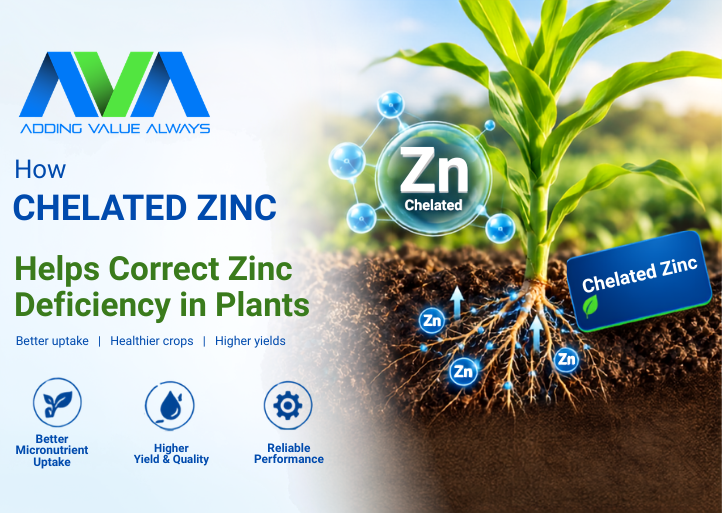
This is where EDTA Zinc, also known as Zinc EDTA or chelated zinc, can play an important role.
By keeping zinc in a stable chelated form, EDTA Zinc provides a water-soluble source of zinc that can be incorporated into different crop nutrition programs, including foliar application, soil application and fertigation.
Let us understand why zinc matters, what Zinc EDTA actually does and how it can be used in agriculture.
What Does Zinc Deficiency Look Like in Plants?
Zinc deficiency is not always easy to identify because symptoms can vary from one crop to another. However, there are some common signs that growers and agronomists can look for.
One of the first symptoms is that the leaves develop yellowing or chlorosis. In some crops, zinc deficiency is primarily noticeable on younger leaves, while in others the symptoms may appear differently depending on the growth stage and severity of the deficiency.
If the deficiency becomes more severe, affected leaves may develop brown spots, necrotic areas or leaf-tip burns.
Another signs can be restricted or stunted growth. Plants may appear smaller than expected, with shorter internodes and reduced development of new tissues.
Some crop specific deficiency symptoms are as follows:
Rice: Lower leaves near base show the signs of chlorosis and zinc deficient plants have brown rusty appearance.
Maize: Interveinal chlorosis and shortened internodes.
Banana: Interveinal chlorosis of young leaves with chlorotic stripes and short, thin twisted fingers.
Tomato: Interveinal chlorosis of older leaves, undercurling of leaflets, and shortened internodes.
Greengram & Pulses: Interveinal chlorosis and stunted plant
Over time, these problems can affect flowering, fruit or seed development and the general health of the crop. Ultimately, an untreated micronutrient deficiency can contribute to a reduction in the crop's yield potential.
Of course, not every yellow leaf means a plant is deficient in zinc. Similar symptoms can be caused by other nutrient deficiencies like Fe or Mg, disease, water stress or root problems. Soil and plant analysis can therefore be useful before deciding on a corrective treatment.
Why Do Plants Need Zinc?
Like we need salt in our food, the plants need zinc in small amounts, but it is involved in several important biological processes.
Zinc supports enzyme activity
Zinc is associated with the activity of several enzymes and proteins involved in plant metabolism. Without sufficient available zinc, some of these processes may not function as efficiently as they should.
It supports normal plant growth
Zinc has an important role in the development of new plant tissues. This is one reason why zinc deficiency can result in shorter plants, smaller leaves and poor overall growth.
It is involved in chlorophyll-related processes
Healthy leaves depend on a number of nutrients working together. Zinc contributes to processes associated with normal leaf development and enhanced photosynthetic activity. It contributes to hormonal and metabolic functions
Zinc is also involved in plant hormone regulation and various metabolic pathways. In simple terms, adequate zinc helps the plant carry out many of the processes required for normal growth and development.
So, while zinc is a micronutrient, its effect on plant performance can be much bigger than the quantity required might suggest.
What is EDTA Zinc?
EDTA Zinc is zinc in a chelated form.
EDTA stands for ethylenediaminetetraacetic acid, a compound that can bind with metal ions such as zinc. When zinc is combined with EDTA, it forms a stable Zn-EDTA complex.
In simplified form:
Zinc + EDTA → Stable Zinc-EDTA Complex
The purpose of chelation is to help keep zinc associated with the chelating molecule and maintain it in a soluble and plant-available form under any adverse soil conditions.
This is particularly relevant in agriculture because the availability of a micronutrient is just as important as its presence.
For example, soils with a higher pH, particularly alkaline soils above pH 7, can make certain micronutrients less available to plants. A chelated zinc source such as Zinc EDTA can be useful in crop nutrition programs where maintaining zinc availability is important.
AVA Chemicals Pvt Ltd makes EDTA Zinc available in different forms, depending on the formulation and intended application. These include:
Disodium Zinc EDTA
Di-Potassium Zinc EDTA
Diammonium Zinc EDTA
The choice between these forms depends on the required formulation, application method and overall nutrient management requirements.
It’s very important to understand the different Zinc EDTA forms and their usage. For example, by using Di-Potassium Zinc EDTA, the two nutrients would be available for the crops, viz. Potassium and zinc. Likewise, with the use of Diammonium Zinc EDTA, ammonium (NH4+) and zinc (Zn) can be utilized by the crops. Although slightly more expensive, this is the main reason why, the western and developed countries are slowly moving towards the use of potassium and ammonium based zinc EDTA.
How Does Zinc EDTA Work?
The easiest way to understand Zinc EDTA is to think of EDTA as a “carrier” or claw that holds the zinc in a stable complex.
A simplified representation is:
Zn²⁺ + EDTA → Zn-EDTA complex
The chelated zinc is easily water soluble and available for plant nutrition irrespective of the soil conditions.
The basic idea can be shown as:
Zinc + EDTA → Stable Chelated Zinc → Better Availability → Plant Uptake
At the chemical level, EDTA has several sites that can coordinate with a zinc ion and form a stable complex. This is one of the main reasons zinc chelate fertilizer is considered when micronutrient availability is a concern.
How Can Plants Take Up Chelated Zinc?
There is no single route through which plants receive zinc. The application method makes a difference.
With foliar zinc application, a Zinc EDTA solution is sprayed onto the leaves. Under suitable conditions, nutrients can move across the leaf surface and contribute to the plant's nutritional requirements.
The simplified pathway is:
Zinc EDTA spray → Leaf surface → Absorption → Zinc availability → Plant processes
Foliar application can be useful when a crop needs additional zinc during a particular growth stage or when soil conditions make nutrient management more challenging.
However, foliar nutrition is not simply about spraying more product. Concentration, water quality, plant condition, crop stage, weather and compatibility with other products all matter.
That is why the recommended application rate and method should always be based on the specific product and crop.
How Can EDTA Zinc Be Applied?
One of the advantages of a suitable water-soluble Zinc EDTA formulation is that it can be used through different application methods.
1. Foliar Application
Foliar spraying delivers the nutrient directly to the plant's leaves.
It can be considered when:
Zinc deficiency symptoms are observed
The crop needs additional micronutrient support
A rapid supplemental application is required
Soil conditions may be limiting zinc availability in the plant
The actual dosage and spray concentration should always follow the product's technical recommendations.
The benefit of using EDTA chelated zinc (Zn-EDTA) is that, due to its wider compatibility, it can be combined with any crop protection (except copper based fungicide) or nutrition. This helps farmers minimize the work and the number of sprays.
2. Soil Application
Zinc EDTA can also be used as part of a soil nutrient management program.
This approach can be particularly relevant where soil conditions affect the availability of zinc. Soil testing is useful for understanding existing zinc levels and determining whether additional zinc is required.
3. Fertigation or Root-Zone Drenching
Where the formulation is suitable, Zinc EDTA can be applied through fertigation systems or as a root-zone drench.
This can be useful in horticulture, protected cultivation and other systems where nutrients are delivered through irrigation.
4. Root Dipping Before Transplanting
For some transplanted crops, roots can be dipped in a suitably diluted liquid Zinc EDTA solution before planting.
This method can provide zinc around the root system during transplant establishment.
What Are the Benefits of EDTA Zinc?
The main reason growers and agricultural formulators consider chelated zinc fertilizer is to provide zinc in a form designed to remain available and easy to apply.
Some of the key advantages include:
Helps manage zinc deficiency
Zinc EDTA provides a source of zinc that can be used as part of a program designed to correct or manage zinc deficiency.
Helps maintain zinc availability
The chelated form helps keep zinc associated with EDTA and can be useful where soil chemistry affects the availability of conventional zinc sources.
Water-soluble
Suitable Zinc EDTA formulations are water-soluble, making them convenient for preparing solutions for foliar application, fertigation and other suitable uses.
Useful in agriculture and horticulture
Chelated zinc can be incorporated into nutrition programs for a wide range of agricultural and horticultural crops.
Suitable for foliar nutrition
Because suitable formulations can be dissolved in water, Zinc EDTA can be used for foliar zinc application when recommended for the crop.
Can be part of an integrated nutrition program
Zinc should not be viewed in isolation. It works alongside nitrogen, phosphorus, potassium and other micronutrients. Zinc EDTA can therefore form part of a broader crop nutrition strategy rather than being considered a replacement for balanced fertilization.
Can EDTA Zinc Be Mixed With Other Agricultural Products?
This is a common practical question, especially when growers want to reduce the number of separate spray applications.
Depending on the formulation, Zinc EDTA is compatible with wider range of pesticides (except copper based fungicides), fungicides, other fertilizers, biologicals and biostimulants.
However, compatibility should never be assumed simply because two products are commonly used in agriculture.
Copper-based fungicide require particular caution, and the compatibility of any proposed tank mix should be checked before application.
Water quality, water pH, concentration and the formulation of the other products can all affect compatibility.
A small jar test is a simple precaution before preparing a large tank mix. Product labels and technical recommendations should always take priority.
EDTA Zinc in Alkaline Soil
Soil pH is one of the factors that can influence micronutrient availability.
In alkaline soils, particularly soils with a pH above 7, zinc especially as zinc sulfate may become less available to plants. This means that simply adding zinc to the soil does not necessarily guarantee that the plant will receive enough usable zinc.
This is where a zinc chelate fertilizer such as EDTA Zinc can have a role.
The EDTA component binds with zinc and helps maintain the nutrient in a stable chelated form. This can support zinc availability under appropriate conditions.
However, EDTA Zinc should not be considered a universal solution for every zinc-related problem. Soil type, pH, crop requirements, existing nutrient levels, irrigation water and application method all need to be considered.
Disodium Zinc EDTA, Di-Potassium Zinc EDTA and Diammonium Zinc EDTA
When searching for Zinc EDTA, you may come across several different forms.
Disodium Zinc EDTA is a commonly used chelated zinc form for agricultural and horticultural formulations.
Di-Potassium Zinc EDTA provides zinc in a potassium-associated form and may be selected depending on the formulation requirements. In Di-Potassium Zinc EDTA, the plant will get the benefit of both the nutrients, viz. Potassium (K) and Zinc (Zn) nutrients.
Diammonium Zinc EDTA is another form used where an ammonium-associated formulation is appropriate and by using this water soluble product, the plant will get ammonium (NH4+) and Zinc (Zn) nutrients..
The important point is that the best form depends on the intended application, formulation requirements, nutrient analysis and crop program.
For manufacturers and formulators, factors such as zinc content, solubility, stability and compatibility can be important when selecting a Zinc EDTA raw material or finished product.
Is EDTA Zinc the Right Zinc Fertilizer for Your Crop?
There is no single zinc fertilizer that is ideal for every crop and every soil.
The right choice depends on the problem you are trying to solve.
If soil testing indicates low available zinc, a soil-applied zinc source may be appropriate. If a crop requires supplemental zinc during a particular growth stage, foliar application may be considered. Where irrigation is used for nutrient delivery, a suitable water-soluble product may be incorporated into a fertigation program.
For alkaline soils or applications where maintaining zinc in a soluble and plant-available form is necessary, chelated form is important, EDTA Zinc can be a valuable option.
The most effective approach is to look at the complete picture—soil condition, crop, growth stage, deficiency level, application method and the rest of the fertilizer program.
Final Thoughts
Zinc may be required in small quantities, but its role in plant growth should not be underestimated.
From enzyme activity and plant development to metabolic and chlorophyll-related processes, zinc contributes to several functions that support healthy crop growth. When zinc is not sufficiently available, plants can show stunted growth, chlorosis, leaf damage,poor crop development and optimum crop yields.
EDTA Zinc provides a practical way to supply zinc in a chelated, water-soluble form. It can be used through foliar application, soil application, fertigation, drenching and, where recommended, root dipping before transplanting.
For growers, formulators and agricultural input manufacturers looking for a chelated zinc fertilizer, Zinc EDTA can be an important tool within a well-balanced micronutrient management program.